
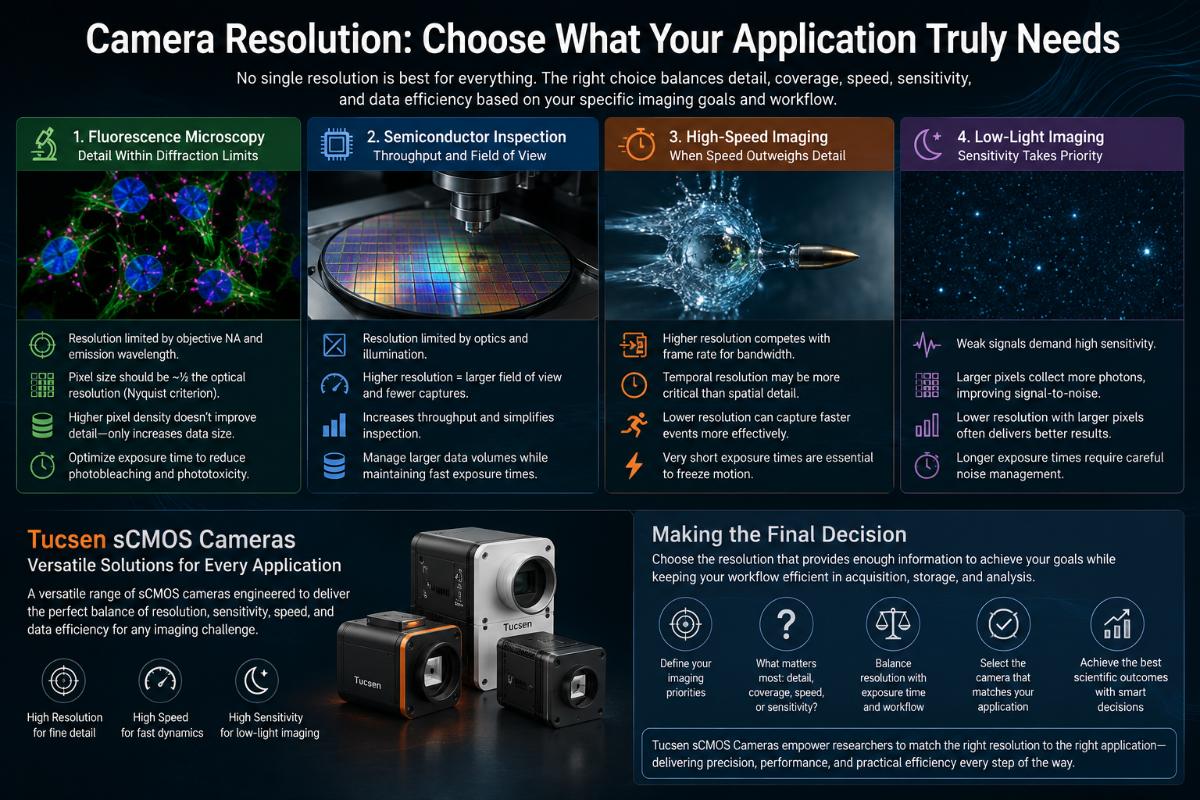
The optimal camera resolution for a given imaging task is fundamentally determined by the specific requirements of the application. No single resolution is universally superior, and the same pixel count may be entirely appropriate for one experiment while proving excessive or insufficient for another. Making effective resolution decisions requires understanding how different applications prioritize detail, coverage, speed, and data efficiency, and how these priorities interact with the capabilities of the optical system and the constraints of the broader workflow. The choice of camera resolution should therefore be driven by application needs rather than by general assumptions about image quality. This application-centric approach leads to more satisfying outcomes and better utilization of laboratory resources.
Fluorescence Microscopy: Detail Within Diffraction Limits
Fluorescence microscopy provides a clear illustration of application-specific resolution requirements. In this technique, the achievable spatial resolution is primarily governed by the numerical aperture of the objective lens and the wavelength of the emitted fluorescence signal. According to the Nyquist criterion, the camera pixel size should be approximately half the optical resolution to ensure adequate sampling without excessive oversampling. Selecting a camera with much higher pixel density than this criterion suggests does not improve structural resolution but does increase file sizes and data handling demands. For most fluorescence microscopy applications, the optimal configuration uses pixels that match the optical resolution, balancing detail with practical workflow considerations. Theexposure time in fluorescence microscopy must also be carefully controlled to minimize photobleaching and phototoxicity while collecting sufficient signal for clear imaging. Researchers must therefore consider both resolution and exposure parameters when configuring their imaging systems for fluorescence applications.
Semiconductor Inspection: Throughput and Field of View
Semiconductor inspection represents a different set of resolution priorities. In wafer inspection, resolution is limited by the optical system and the illumination conditions, and the primary benefit of higher pixel counts is not enhanced detail but improved throughput and larger field of view. Cameras with higher resolution allow inspectors to image larger areas of the wafer in a single capture, reducing the number of acquisitions required for comprehensive inspection. This increases throughput and simplifies the inspection process, but it also generates larger data volumes that must be processed and analyzed. The trade-off between field of view and data management is central to selecting an appropriate resolution for semiconductor inspection. In this context, the exposure time can often be optimized for the high-intensity illumination used in inspection systems, allowing for fast acquisitions even at higher resolutions. The inspection environment typically provides stable, bright illumination that reduces the constraints imposed by sensitivity requirements.
High-Speed Imaging: When Speed Outweighs Detail
High-speed imaging applications introduce yet another set of considerations. In these experiments, capturing rapid dynamics often requires frame rates that challenge the data transfer capabilities of the imaging system. Higher resolution directly competes with frame rate for bandwidth, as both require data throughput capacity. Increasing resolution without upgrading the interface or processing hardware will inevitably reduce the achievable frame rate. For applications involving fast motion or short-lived phenomena, the temporal resolution may be more critical than spatial detail, and a lower-resolution camera may produce more informative data than a high-resolution model that cannot capture the relevant timescale. Exposure time in high-speed imaging must be extremely short to freeze motion, which further constrains signal collection and emphasizes the importance of sensitivity over resolution. Researchers working in this domain often prioritize cameras that offer the best balance of speed and sensitivity rather than maximum pixel count.
Low-Light Imaging: Sensitivity Takes Priority
Low-light imaging presents a different resolution challenge. In these applications, the signal is inherently weak, and detection sensitivity is paramount. Larger pixels collect more photons during a given exposure time, improving the signal-to-noise ratio and enhancing the ability to detect faint signals. The resolution in low-light systems is often deliberately limited to maintain larger pixel sizes and preserve sensitivity. High pixel density does not necessarily improve imaging quality when the sample emits only a few photons per pixel. In this context, a lower-resolution camera with larger pixels can outperform a higher-resolution model with smaller pixels, producing images that are cleaner and more informative despite containing fewer total pixels. The exposure time in low-light imaging is typically extended to accumulate sufficient signal, which requires careful management of dark current and thermal noise. Researchers in this field must carefully balance resolution against sensitivity to achieve usable results.
Tucsen sCMOS Cameras: Versatile Solutions for Every Application
Tucsen sCMOS Camerasare designed to address these diverse application requirements through a range of configurations that balance resolution, sensitivity, speed, and data handling. Researchers selecting a camera should first define their primary imaging priorities based on the specific experimental goals. Is spatial detail the most critical parameter, or does the experiment require broad coverage? Is acquisition speed more important than ultimate resolution, or does the sample remain static, allowing longer exposures? Answering these questions provides a framework for evaluating resolution options that leads to practical, cost-effective decisions. Tucsen sCMOS Cameras offer the flexibility to address these varied priorities, with models optimized for high-resolution detail, high-speed acquisition, and low-light sensitivity, ensuring that researchers can match thecamera resolution to their specific application requirements. By offering such diverse options within a single product family, Tucsen simplifies the process of finding the right camera for each unique imaging challenge.
Making the Final Decision
The most effective resolution choice aligns with the real constraints and opportunities of the imaging workflow. Rather than pursuing the highest pixel count available, researchers should focus on the resolution level that provides sufficient information for the experimental objectives while maintaining practical efficiency in data acquisition, storage, and analysis. This application-driven approach ensures that the selected camera contributes meaningfully to research success without introducing unnecessary burdens. With their diverse product portfolio and flexible configuration options, Tucsen sCMOS Cameras support this approach by enabling researchers to select the resolution that best matches their specific application requirements and workflow constraints, while providing precise exposure time control to optimize image quality across different experimental conditions. The ultimate goal is to achieve the best possible scientific outcomes with the resources available, and making thoughtful resolution decisions is an important step toward that objective.